



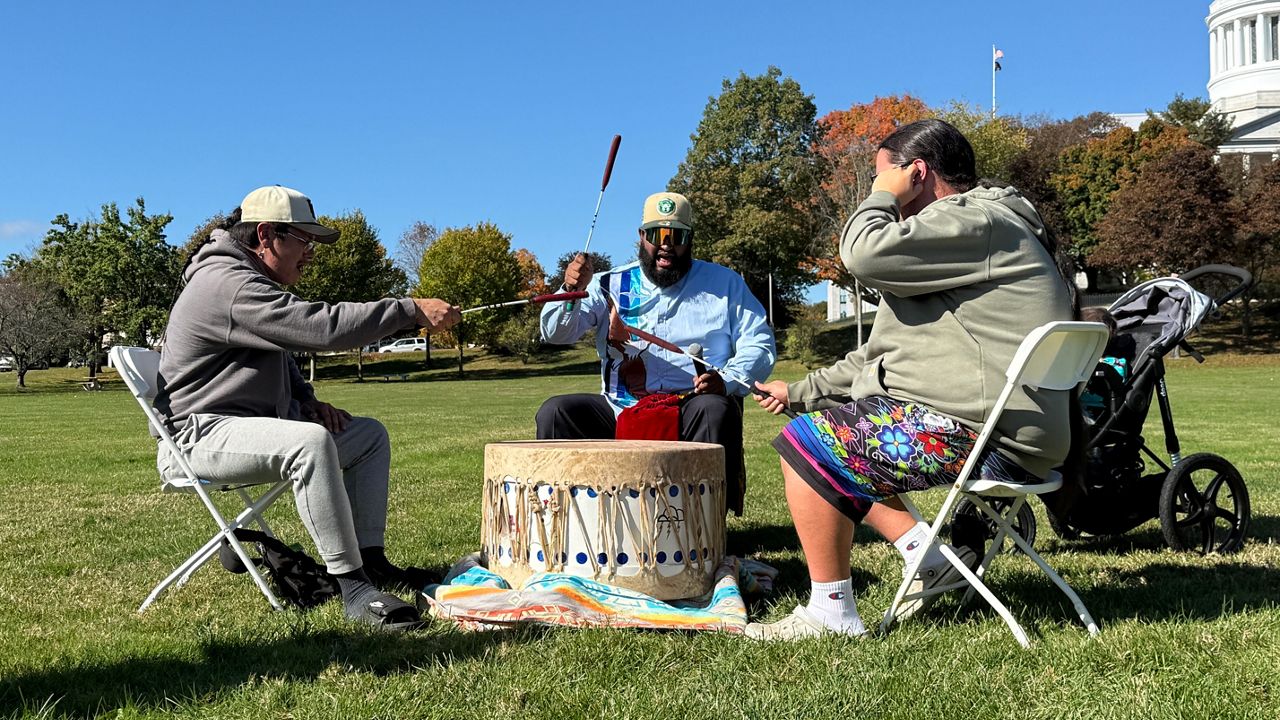
AUGUSTA — Citizens of the four tribes in the Wabanaki Alliance gathered in Augusta to celebrate Indigenous Peoples’ Day on Monday.
Four tribes make up the Wabanaki Alliance in Maine: the Houlton Band of Maliseet Indians, Mi’kmaq Nation, Penobscot Nation and the Passamaquoddy Tribe. These four tribes banded together in 2020 to educate people in Maine about their fight to have their sovereignty recognized by the Maine government, according to the Alliance’s website.
In 1980, Congress passed the Maine Indian Claims Settlement Act, which has kept tribal lands and affairs under state jurisdiction. It also prevents federal laws that apply to Indigenous People in the country from applying to any of the tribes in Maine unless the state approves, among other restrictions.
The Wabanaki Alliance has been calling for the State of Maine to recognize its sovereignty since its founding. In 2023, Gov. Janet Mills vetoed a bill that would have allowed citizens of the tribes to access the federal laws that benefit the other 570 federally recognized indigenous tribes in the country. Mills said she vetoed the bill because it was complicated and incomplete.
The alliance recently endorsed Democrat Hannah Pingree for governor following her pledge to pass legislation to grant the tribes full sovereignty in her first 100 days in office. Independent Rick Bennett has said he fully supports sovereignty as well. Republican Bobby Charles said he’ll meet with tribal leaders to consider their request.
But Monday’s event wasn’t just about politics. Wabanaki Alliance Executive Director Maulian Bryant said the event was a day of celebration and education surrounding the four tribes.
“There's a lot of buzz around how contentious and chaotic and tense the tribal/state relationship can be, and of course we’re doing a lot of hard work to restore the recognition of our sovereignty,” Bryant said. “And I think sometimes it feels good to connect around a celebration.”
The day began with a song performed by Clarissa Sabattis, chief of Houlton Band of Maliseet Indians, about the Wolastoq River, also called the St. John River. Then, former Penobscot Nation Chief Barry Dana gave a speech and shared stories about his first days as chief and his experience advocating for the rights and sovereignty of the Penobscot Nation.
“It’s simple,” Dana said. “There’s a model already out there, it’s called federal recognition. Just take it in. That’s not asking a lot. That’s asking like, for a vaccination shot if they’re available.”
Following the speeches, people gathered to dance to drumming and singing. There were artisan demonstrations, like ash basket making, and the alliance planned to show two films — “We Are the Warriors,” a film about a 2017 event in Wells, Maine, in which an offensive mascot was removed from a high school, and “Bounty,” a historical film about bounty hunters in New England scalping Indigenous People for pay.
Though this was the first such gathering by the Wabanaki Nations on Indigenous Peoples’ Day, Bryant said she hopes this event will continue in the future.
“We are all neighbors and friends, and this is such a good point of connection for us,” Bryant said.